


Unmanned Nano Helicopter to Boost Turkish Army’s Capabilities
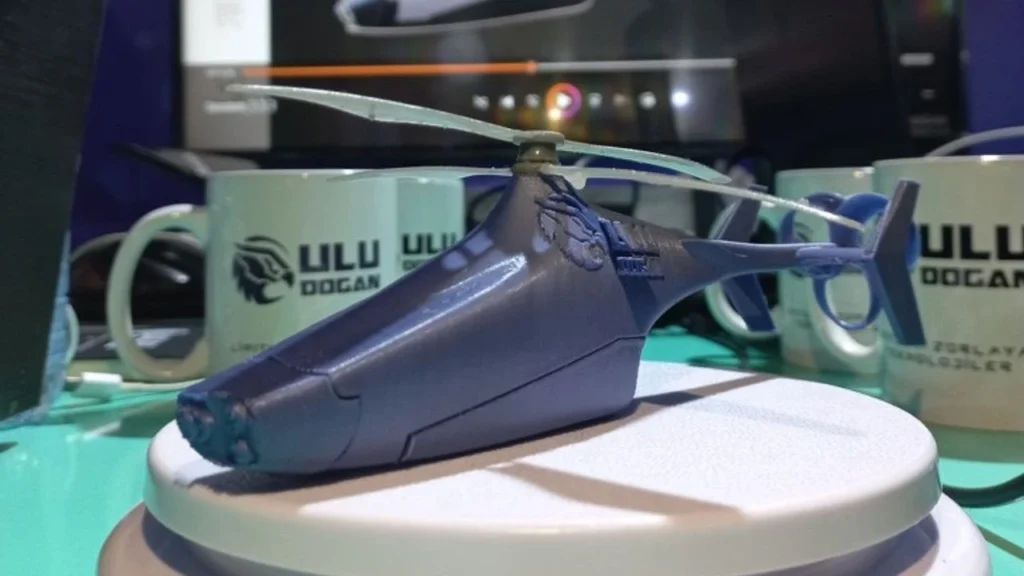
The “Unmanned Nano Helicopter,” currently under development by Uludoğan Defense Industry Technology, a company operating within the Karabük University (KBÜ) Technology and Development Zone (TEKNOKENT), will end Turkey’s dependence on foreign imports and enhance the strength of the Turkish Armed Forces (TSK).
The project titled “Unmanned Nano Helicopter” developed by the company was one of 45 projects in the defense industry sector that won support among 833 projects within the framework of the TÜBİTAK 1501 Industrial R&D Projects Support Program.
Within the framework of the “Development Project for a Nano-Class Unmanned Helicopter Suitable for Military and Civilian Use in Search and Rescue Observation Activities in Closed and Restricted Areas,” a Nanocopter and Flight Control System will be developed for use in military operations, disasters, earthquakes, and search and rescue activities.
The project, which is planned to be the first in Turkey and the second in the world, aims to be a domestic and national micro-level Unmanned Aerial Vehicle (UAV) system with certain advantages over its competitors.
Seyfeddin Cevdet Uludoğan, Chairman of the Board of Directors of Uludoğan Defense Industry Technology Company and Senior Engineer, stated that their field of work is unmanned helicopters.
Uludoğan stated that they are supporting a nano-class helicopter project, called the “Development Project for a Nano-Class Unmanned Helicopter Suitable for Military and Civilian Use in Search and Rescue Observation Activities in Enclosed and Restricted Areas.” He added, “In this context, we have brought our project to a certain point with our colleagues. Our work continues at THS 4 level, and our goal is to reach THS 9 level and have our project ready for mass production in 2025.”
Ending external dependency
Uludoğan stated that upon completion of the project, they will be the second company in the world to complete an unmanned helicopter project in this class, adding, “With this helicopter, we aim to develop an unmanned helicopter project suitable for military intelligence and special forces use. The importance of this project lies in the fact that it is developed and used by only one company in the world, with no second company existing. We plan and aim to emerge as a domestic competitor from Turkey. If we successfully complete this project, we will hopefully become the second company in the world to complete an unmanned helicopter project in this class. We will first end our dependence on foreign sources in this area and produce a domestic solution for military strategic purposes. The added value share of the product we produce is very high. The price of an unmanned helicopter in this class is around $200,000. We aim to produce this with domestic capabilities and offer it to our army at more affordable prices,” he said.
“A product with many advantages”
Referring to the technological superiority of the project, Uludoğan noted:
“In terms of added value, it is a product with a very high export price per gram. It incorporates high technology. It is very difficult to fit such high technology into such a small device, so there is currently no other company in the world that can do this. We can say that our Unmanned Nano Helicopter has a higher field of view, a more advanced artificial intelligence module, and a longer flight time and endurance in adverse weather conditions. With its coaxial rotor structure and rear propeller, we have more stable flight and faster maneuverability. It is a product with many advantages, and we are continuing the project with a more innovative approach. We are not imitating our competitor; we are working on a completely new product in that class.”
In determining the technological dimension and R&D content of the project, Prof. Dr. Raif Bayır, a member of the Mechanical Engineering Department at KBÜ Faculty of Engineering who provides academic consulting services on the aerodynamic design of the nanocopter, the company’s strategic planning, and project management, also stated, “Our company, operating within the Karabük University Technology Park, has settled in our Technology Park with a project to develop an unmanned aerial vehicle at the nanocopter level. We have a well-established university-industry collaboration in developing the R&D content and technological dimension of the project, preparing the TÜBİTAK project, and ensuring its applicability to industry. We provide them with academic consulting services to help them make the best use of our university’s laboratories, facilities, and the opportunities offered by this Technology Development Zone.”